July 10, 2026
Large-Diameter and Cross-Country Pipeline Construction
What large-diameter, cross-country pipeline construction actually involves, how these big transmission lines get planned and built, and what sets the work apart.
Key takeaways
- Large-diameter, cross-country lines are the backbone of the system: bigger pipe, higher pressure, moving product over long distances across open country.
- The work is not harder than a short line, it is bigger. Success comes from planning the route and sequencing the crews, not from any single trick.
- Terrain drives the plan. Rock, water, wetlands, roads, and rail each need their own approach, and the design has to account for all of them up front.
- Real capacity is measured in spreads and crews, not company size. A contractor that can crew and stack your route is the one to listen to.
A developer once described the line they were planning as “a big one,” then paused and asked if that was going to be a problem. It is a fair question if you have never built pipe before. The honest answer is that a large-diameter, cross-country line is not a harder version of a small job. It is a bigger one, and bigger is a matter of planning and crews, not a matter of some special trick.
Large-diameter, cross-country lines are the backbone of the pipeline system. They are the pipe that moves gas and liquids the long distances between where product is produced and where it gets used. If you are trying to understand what this work involves before you hire a contractor, it helps to start with what the words actually mean.
What “large-diameter” and “cross-country” mean
Large-diameter is the bigger transmission pipe. There is no single number that draws the line, but the idea is simple: transmission pipe is larger in diameter, runs at higher pressure, and carries product over long distances. Distribution pipe is the smaller pipe that steps down off that system and carries product the shorter distances to where it is used. Both take real expertise, and both are work we self-perform, but they are different jobs.
Cross-country is exactly what it sounds like. Instead of running through a developed corridor, the line crosses open ground: farmland, pasture, ridges, creeks, and everything in between. That route is what shapes the whole job. It decides how the pipe gets planned, where the hard crossings are, and how the crews get sequenced down the right-of-way.
Put the two together and you have the kind of line that carries the most product the farthest. It is also the kind of line where planning and crew management matter most.
The work is bigger, not harder
Here is the part that surprises people. Stacking a short line and a long line is the same work. You line up the same crews in the same order, and the longer line just runs longer. The sequence does not change because the pipe got bigger or the route got longer.
What changes is scale. A cross-country line crosses more roads, more water, and more property, so there is more to plan and more to permit. There is more pipe to move, weld, and coat, so there are more crews to field and keep in balance. None of that is a different kind of work. It is the same work, organized at a larger size, which is why the contractors who do it well are the ones who can plan a route and run a spread, not the ones with the biggest logo.
Planning the route comes first
On a big line, the route is the plan. Before a single crew shows up, the line has to be surveyed and staked, the crossings identified, and the pipe specified for the pressure and the product it will carry. Permitting runs alongside all of it, because a cross-country line crosses roads, rail, water, and property, and each crossing has its own approval.
Permitting is often the slowest part of the whole job, and it does not wait for anyone. That is why the design has to be drawn with the permits in mind from the start, so a crossing does not get engineered one way and then have to be redrawn when the approval comes back different. Getting the route, the pipe, and the permits lined up early is what keeps the construction phase from stalling later.
Building it, stage by stage
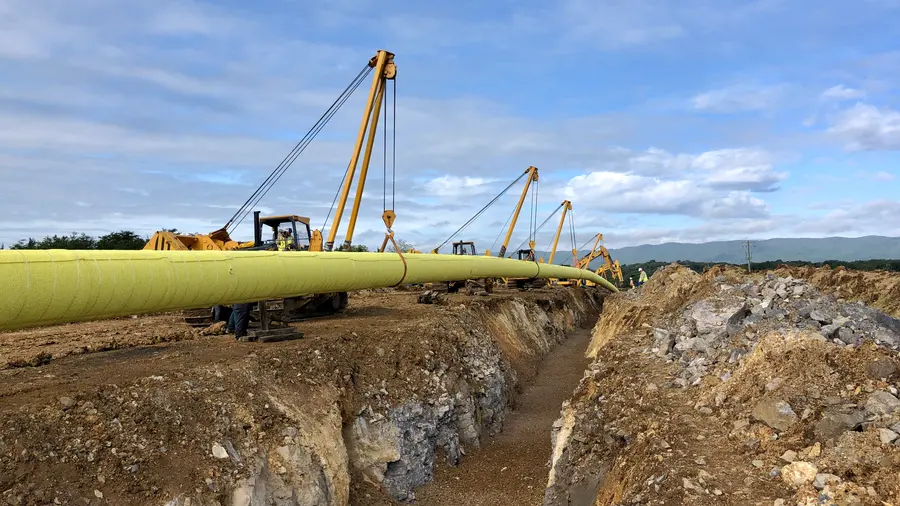
Once the plan is set, the line gets built in a sequence of stages that move down the right-of-way in order. The short version looks like this: survey and clear the right-of-way, string and bend the pipe along the ditch, weld it into one continuous line and inspect every weld, coat the joints, dig the trench and lower the welded line in, backfill, hydrostatically test it to prove it holds pressure, and restore the land. Each stage is its own crew with its own skill set, and there is a longer walk-through of that whole process in our post on how a pipeline project comes together.
On a large-diameter line, the equipment is bigger and the sidebooms lower a heavier string, but the order is the same. The trick, if there is one, is keeping the crews in balance so no stage gets too far ahead of the one behind it. When the welding gets ahead of the ditch, or the coating crew falls behind the lower-in, the whole operation slows down. Keeping that rhythm is the real work of running a big spread.
Terrain and crossings drive the job
The route decides where the hard parts are. Open pasture is straightforward. Rock slows the trenching. Wet ground and river bottoms change how the pipe is handled and lowered in. A highway, a rail line, or a sensitive water body usually cannot be trenched at all, so the line goes under them using a trenchless method like horizontal directional drilling, which bores a path underground and pulls the pipe through behind it.
The point is that a cross-country line is rarely one kind of terrain from end to end. It is a series of conditions strung together, and the plan has to account for each one before the crews get there. A contractor who has walked the route and thought through the crossings is a long way ahead of one who has not. If you want a plain-language reference for the terms that come up along the way, the glossary is built for that.
Capacity is crews and spreads, not company size
The most common worry we hear on a big line is whether a privately owned contractor is big enough for it. It is worth saying plainly: capacity in this business is measured in spreads and crews, not in the size of the company. A spread is the full assembly line of crews working a section of the route, and when a line is long enough, you do not build one endless spread, you add spreads and coordinate where they meet.
That is why self-performing the work matters so much on a large line. When the crews are your own, you control the pace directly and there are fewer hand-offs where the schedule can slip. A contractor who can walk you through how they would crew and stack your specific route, section by section, has actually thought about your project. One who just talks about how big they are has not.
What makes a big line go smoothly
On a line this size, the difference between a job that stays on schedule and one that slips is rarely one big thing. It is a lot of small things handled in the right order. The route gets walked before the crews arrive. The long-lead pipe and materials get ordered against the real design and the real schedule, not after a hand-off delay. The permits get chased early, because they are usually the part with the least give. And the crews get sequenced so each stage feeds the next without a gap.
Communication is the other half of it. On a big job, something always comes up, and what protects your schedule is how fast you can get a real answer when it does. That is one reason we have stayed privately owned: the person who can make a decision is close to the work, not five rungs up a corporate ladder. When a crossing has to change or a schedule needs a call, you are talking to someone who can actually say yes.
None of this is complicated, but it takes a contractor who has run large-diameter work before and knows where the schedule usually breaks. Asking how a contractor would plan and crew your specific line is one of the better questions to ask before you sign, because the answer tells you whether they have thought about your project or just want the work.
Talk it through before you commit
If you have a large-diameter or cross-country scope coming up, the most useful thing you can do is bring a contractor into the conversation early, while the route and the schedule are still being shaped. We build large-diameter and cross-country transmission line with our own union crews, and we will tell you straight what is realistic on routing, permits, and schedule before you are locked into dates you cannot hit.
Request a bid or just get in touch and tell us about the line, even if all you have is a route drawn on a map.
Frequently asked questions
What counts as a large-diameter pipeline?
There is no single cutoff, but large-diameter usually refers to the bigger transmission pipe that moves gas or liquids long distances at higher pressure, rather than the smaller distribution pipe that ties off the system closer to where the product is used.
What makes cross-country construction different from a shorter line?
The sequence of work is the same, but a cross-country line crosses more terrain, more roads and water, and more property. That means more planning, more permitting, and more crews stacked in the right order to keep the spread moving.
How is a cross-country pipeline actually built?
In stages that move down the right-of-way: survey and clear, string and bend the pipe, weld and inspect, coat the joints, dig and lower in and backfill, hydrostatically test, and restore the land. Each stage is its own crew and skill set.
Does a large line need a large contractor?
Not necessarily. Capacity comes from spreads and crews, not from the size of the company. What matters is whether the contractor can field and run the crews and superintendents to keep the work moving.