June 2, 2026
What Is HDD (Horizontal Directional Drilling)?
How pipelines cross under roads, rivers, and wetlands without an open trench, and how to tell when HDD is the right call on a project.
Key takeaways
- HDD is a trenchless method that bores a steerable path underground, then pulls the pipe through behind the bore.
- It is used to cross under highways, railroads, rivers, creeks, and sensitive wetlands without cutting an open trench.
- Success depends on the design: pipe specs, depth, entry and exit angles, curve radius, and soil along the path.
- On many permitted crossings, HDD is not just the better option, it is the only one an agency will allow.
- A team that engineers and drills the crossing under one roof reduces surprises in the field.
Sooner or later a pipeline reaches something you cannot dig straight through. A four lane highway. A river with a permit protecting every foot of the bank. A rail line that will not close for anyone. Horizontal directional drilling, usually shortened to HDD, is how the line gets to the other side without tearing open the surface.
If you have ever driven over a highway and never known a gas line runs beneath it, you have already seen the result of a good HDD crossing. Nothing about the road tells you it is there. That quiet is the whole point, and it is one of the trenchless methods we self-perform as part of our specialized pipeline services. Getting it right takes more planning than most people expect, so it helps to understand what is actually happening below ground.
How HDD actually works
HDD is a trenchless method, which means no continuous trench gets cut across the obstacle. The work happens in three moves, and it is worth picturing each one.
First comes the pilot bore. A steerable drill bit starts at an entry point on one side, angled down into the ground, and follows a designed curve toward an exit point on the far side. The operator does not drill blind. Pressurized drilling fluid clears the cuttings and stabilizes the hole, and a tracking tool reports the bit’s depth and position so the crew can steer along the planned line. That underground path is called the bore.
Once the pilot bore reaches the exit, the hole gets enlarged in one or more passes, a step called reaming, until it is wide enough for the pipe plus a working margin. If any of these terms are new to you, our glossary of pipeline terms keeps plain definitions in one place. Then comes the payoff. The pipeline, welded and tested into one continuous string on the exit side, is connected to the drill string and pulled back through the reamed hole to the entry side. Bore, ream, pull. When the pull is done, the pipe sits in the ground along the curve the design drew, and the surface above never opened.
The surface staying intact is the entire value. The road keeps carrying traffic, the river keeps flowing, and the line passes safely underneath while the crew works from two tidy sites on either side.
When HDD is the right call
HDD is the tool you reach for when an open trench is impractical, not permitted, or simply a bad idea. A few situations come up again and again.
Crossings under highways and railroads are the classic case, because closing a road or a rail line to trench across it ranges from expensive to impossible. Water crossings are another, whether a wide river or a modest creek, since disturbing a channel and its banks brings real environmental cost and heavy permitting. Wetlands and other sensitive ground fall in the same category, where regulators want the surface left alone. And in congested corridors thick with existing utilities and traffic, going underneath beats tearing up the street.
Here is the part people miss. On a lot of these crossings HDD is not just the cleaner choice, it is the only method a permit will allow. That is a big reason it sits at the center of our horizontal directional drilling service, alongside the water and wetland work it so often supports. An agency protecting a river or a wetland often writes the requirement so that a trenchless crossing is the sole path forward. At that point the question stops being whether to use HDD and becomes how to design it well.
Why the engineering makes or breaks it
HDD lives and dies on the planning. A crossing that looks simple on a map can turn into a fight with the ground if the design skips a step, so the up front work carries real weight.
The design has to account for the pipe specifications, the depth of the bore, the entry and exit angles, the radius of the curve the pipe can tolerate without overstressing it, and the soil conditions along the whole path. Steel pipe can only bend so far, so the curve has to stay gentle enough to protect it during the pull. Depth has to give enough cover to satisfy the permit and stay below a riverbed or a road, while keeping the bore in soil the rig can actually work. Get those pieces right and the pull goes smoothly. Get them wrong and the crew fights the hole the whole way, which costs time and, on a permitted crossing, patience nobody has to spare.
This is also where HDD connects to the larger idea of a spread. If you want the fuller picture of how crews and equipment stack up on a pipeline job, our explainer on what a spread is in pipeline construction puts the drilling work in context with everything else moving on a project.
Reading the ground before you drill
The single biggest variable in an HDD crossing is what the drill has to pass through, and you want to know that before the rig shows up, not after.
A geotechnical investigation, meaning borings and soil testing along the planned alignment, tells the design team what they are drilling into. Clean sands, firm clays, and soft rock tend to behave, holding the hole and letting the crew steer with confidence. Cobble, boulders, and fractured rock are the troublemakers, because they make steering unpredictable and can let drilling fluid escape where you do not want it. When the ground looks difficult, the design adapts. The team may adjust the depth to find better material, change the entry and exit points, or plan the fluid program around the conditions.
Skipping that homework is how crossings go sideways. A bore planned on a guess can hit rock nobody expected, stall the pilot pass, or lose returns partway through. Spending the effort to understand the soil early is far cheaper than discovering it the hard way with a rig sitting idle.
The people and equipment on site
An HDD crossing is a coordinated operation with a lot moving at once, and the two ends of the bore are doing different jobs.
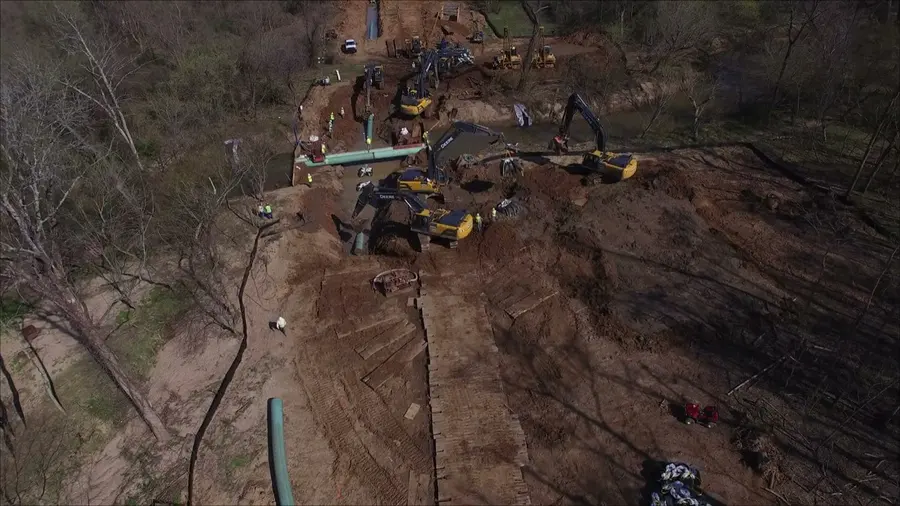
On the entry side sits the drill rig, the power unit, and the fluid system that mixes, pumps, and recycles the drilling fluid that clears the hole and carries the cuttings out. On the exit side, the crew welds the pipe into one continuous string, coats and inspects the joints, and stages it so it can be pulled in without kinking or scraping. Managing the drilling fluid runs through all of it, since keeping the hole stable and the returns under control is much of the craft. Do that well and the surface stays clean and the bore stays sound.
Because the design, the drilling, and the pullback all feed into one another, a crossing tends to go best when one experienced team owns the whole sequence rather than splitting it across firms. That is a big reason HDD pairs naturally with design-build and EPC delivery, where the same group that engineers the crossing is the one out there drilling it. When a question comes up in the field, the answer does not have to travel through three companies to get resolved.
How the crossing gets decided
Picture a developer with a route that has to reach a facility on the far side of a creek and a county road. The map shows the obstacle, but not the method. Choosing HDD is a judgment call built from a handful of questions.
What does the permit require, and does the protecting agency mandate a trenchless crossing? What is the ground made of along the alignment? Is there room on both sides to set up an entry and an exit site and to string out the pipe for the pull? How long and how deep does the bore need to be to clear the obstacle with proper cover? The answers point toward HDD or, sometimes, toward another approach entirely. An honest contractor will tell you when a crossing is a clean fit for directional drilling and when it is genuinely tricky, rather than promising a smooth pull on ground nobody has tested.
That candor matters more than it sounds. A crossing sold as easy and delivered as a struggle costs everyone. A crossing scoped honestly, with the soil understood and the design done properly, is the one that ends up invisible under the road the way it should be.
Get in touch and tell us about your project, even if all you have is a line on a map and a river in the way. Reach out through our contact page and we will walk you through what is realistic for your crossing and how the numbers are likely to shake out.
Frequently asked questions
What does HDD stand for?
HDD stands for horizontal directional drilling. It is a trenchless installation method that steers a drill underground along a designed curve so a pipeline can pass beneath an obstacle without an open trench.
How is HDD different from open-cut trenching?
Open-cut trenching digs a trench across the obstacle, lays the pipe, and backfills. HDD leaves the surface intact by boring a path underground and pulling the pipe through. That difference matters most under roads, water, and protected ground.
How deep does an HDD bore go?
Depth depends on the crossing. The design sets enough cover to protect the pipe and satisfy the permit, while staying in workable soil. A river crossing usually runs deeper than a simple road crossing to keep the bore below the channel bottom.
Can HDD be used in any soil?
Not equally well. Clean sands, clays, and soft rock tend to drill predictably. Cobble, boulders, and fractured rock make steering and fluid control harder. A geotechnical investigation up front tells you what you are drilling into before the rig arrives.
Who should plan an HDD crossing?
People who do it regularly. The design, the drilling, and the pullback all connect, so the crossing goes best when one experienced team owns all three rather than splitting them across separate firms.