August 28, 2026
Trench Safety and Shoring on Pipeline Construction Projects
What trench safety and shoring mean on a pipeline job, why OSHA excavation rules apply, and what to expect from a contractor's protective systems.
Key takeaways
- A trench collapse can happen in seconds, which is why protective systems are not optional on a pipeline job.
- Federal rules require a competent person to classify the soil and inspect every trench before crews go in it.
- Protective systems take a few forms: sloping, benching, shoring, and trench boxes, each suited to different soil and depth.
- Ask a contractor how they run trench safety day to day. Daily inspections and a documented program tell you more than a policy on paper.
- Done right, trench safety is built into the sequence, not bolted on, so it keeps a spread moving instead of stopping it.
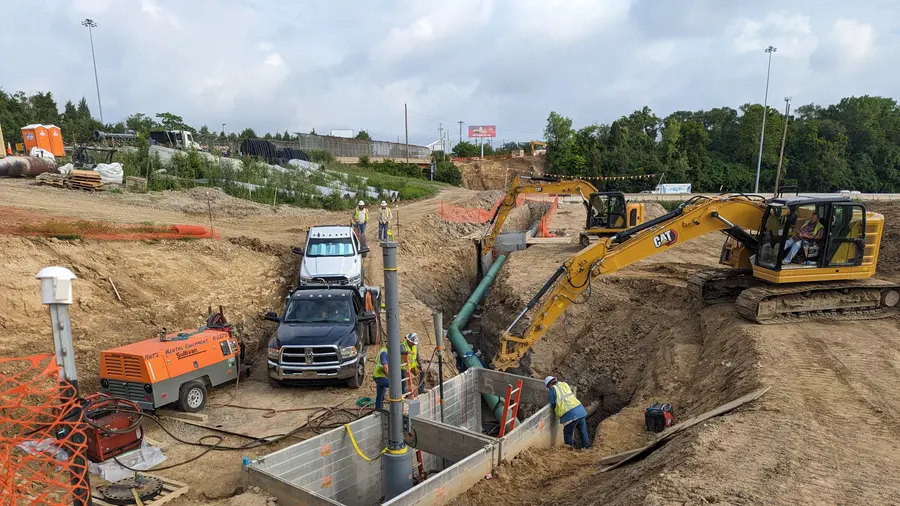
A utility engineer walked a right-of-way for the first time last spring, checking on a distribution tie-in for a facility she managed. The ground looked ordinary: dry, packed, nothing that looked like a hazard. Then she got to the open trench where a crew was working a weld, and there was a steel box sitting inside it, walls braced apart, workers moving inside the box rather than against bare dirt. She asked why. The ground looked fine.
That question comes up more than you would think, especially from people who are buying pipeline work for the first time and have never had a reason to think about what happens below grade on a jobsite. The honest answer is that soil that looks fine from the surface is not the same thing as soil that is safe to stand next to unprotected, and the industry has learned that the hard way. Trench safety is one of the less visible parts of pipeline construction safety, but it is one of the most important.
Why an open trench is more dangerous than it looks
A pipeline trench is not a static hole in the ground. It is an excavation that stays open for hours or days while crews work inside it or right beside it, welding joints, inspecting welds, and setting the line in before backfill. Soil that held its shape when the excavator first dug it can shift as it dries out, as equipment vibrates nearby, or as water works its way in from rain or groundwater. None of that has to be dramatic to be dangerous. A wall does not need to fully collapse to injure someone. Even a partial slide can pin or crush a worker standing at the bottom of a trench that is only a few feet deep.
What makes it deceptive is that a trench can look completely stable right up until it is not. There is rarely a warning that gives a crew time to react, and by the time soil starts moving, there is often no time left to get clear of it. That is why the industry does not leave the call up to a visual guess. It treats every trench as a hazard to be managed, not a hole to be trusted, no matter how many times crews have worked that same stretch of ground without incident.
What trench protective systems actually are
There are a few accepted ways to protect crews working in or near an open trench, and which one gets used depends on the soil, the depth, and the site conditions.
- Sloping cuts the trench walls back at an angle so they cannot collapse straight down on anyone.
- Benching steps the walls back in stages rather than one continuous slope.
- Shoring uses a support structure, often hydraulic, braced against the trench walls to hold them apart.
- Trench boxes and shields are pre-built steel structures lowered into the trench that crews work inside, so the box takes the load instead of the crew.
None of these are interchangeable. A method that works in dry, stable ground can be the wrong call in loose or wet soil, which is exactly why the decision does not get made casually or once at the start of the job. It gets made trench by trench, and it gets checked again as conditions change.
The rules behind the practice
Excavation and trenching are regulated under federal workplace safety standards, and the requirements are specific rather than general guidance. Soil has to be classified by type before a decision is made about protection. Trenches past a certain depth require a protective system unless the excavation is cut entirely in stable rock. Spoil piles and equipment have to be kept back from the edge so they do not add weight that pushes a wall toward failure. There has to be a safe way in and out of a deep trench, not just a ladder wherever one happens to be handy.
These are not abstract requirements written for an office. They come out of decades of incidents in excavation work generally, pipeline construction included, and they exist because trench collapses are one of the more preventable causes of serious injury in this line of work when the rules are actually followed.
That last point is worth sitting with. Trench safety failures are almost never the result of a hazard nobody could have anticipated. They tend to trace back to a step that got skipped: a trench opened without a protective system because the crew was moving fast, a spoil pile left too close to the edge, or a wall that was reassessed once at the start of the day and never again. The standards exist because those are predictable failure points, and predictable failure points can be planned around.
The competent person is the one who decides
Every one of those calls, soil classification, which protective system to use, whether conditions have changed enough to stop and reassess, runs through a specific role: the competent person. It is not an honorary title. It means someone on the crew has the training to recognize a hazard developing in a trench and the authority to act on it immediately, including stopping work if something does not look right.
That inspection is not a one-time check at the start of the day. Conditions in a trench can change with weather, with vibration from nearby equipment, or simply with time, so the competent person is expected to reinspect after anything that could affect stability. On a job that runs a trench for days at a stretch, that habit of rechecking is what actually keeps people safe, far more than the paperwork that gets filed afterward.
How this fits into a contractor’s broader safety record
Trench safety rarely shows up on a sales sheet the way a certification does, but it is one of the clearest signs of how seriously a contractor treats safety day to day. A contractor that is Gold Shovel Certified and current on the systems clients check has already been vetted on programs like this, but a certification only tells you the paperwork is in order. What tells you more is whether the crews on the ground actually run the program the way it is written, trench after trench, without cutting it short when the schedule gets tight.
That distinction matters more for buyers in gas and energy operations who are used to vetting contractors on paper, and even more for a buyer who has never had to vet one at all. Reading a safety binder tells you what a company says it does. Watching how a crew handles an ordinary trench on an ordinary day tells you what it actually does.
It also matters because trench work is one of the few parts of a pipeline job where a shortcut is invisible until it fails. A weld that was rushed can be caught by inspection. A trench wall that was not properly shored usually is not caught by anything, until it is caught by someone standing in the trench.
What to ask before you hire
If trench safety is not something you have had to think about before, you do not need to become an expert in soil classification to ask the right question. Ask a contractor how they classify soil on site, what protective systems they typically use, and how often an open trench gets reinspected once work is underway. A contractor who runs a real program will answer specifically: who the competent person is on a given crew, what would trigger a change in shoring, and how that gets documented. A vague answer, or one that treats the question as unusual, tells you something too.
These are the kind of details worth adding to the list of questions you bring to any contractor conversation, right alongside self-perform capability and safety certifications. A contractor that has actually done this work will not be caught off guard by the question.
Doing it right does not have to slow the job down
The common assumption is that trench safety is a drag on schedule, another step standing between the crew and progress. In practice, the opposite tends to be true. A crew that treats protective systems as part of the normal sequence, planned into how the trench is opened and worked, moves steadily because nobody has to stop and improvise a fix after something starts to go wrong. The jobs that lose real time to trench issues are usually the ones where safety was treated as an afterthought rather than part of the plan.
Trench safety is not the most visible part of a pipeline construction project, but it protects the people doing the most exposed work on the job, and it is worth understanding before you are the one signing a contract. If you have a project coming up and want to talk through what a safe, well-run spread actually looks like, get in touch and we will walk you through it.
Frequently asked questions
What is trench shoring in pipeline construction?
Shoring is a protective system, often a hydraulic or timber support structure, installed inside a trench to hold the walls apart and keep them from collapsing on the crew working inside. It is one of several methods used to protect an open excavation, along with sloping, benching, and trench boxes.
Why is trench safety such a big deal on a pipeline job?
Pipeline construction runs miles of open trench, often several feet deep, with crews working inside it to weld, inspect, and lower in the line. Soil can look solid and still fail without warning, and a collapse can bury or crush a worker in seconds. That risk is why protective systems and daily inspections are standard practice, not an extra step.
Who decides whether a trench needs a protective system?
A designated competent person on the crew, someone trained to classify the soil, recognize hazards, and choose the right protective system for the depth and conditions. Federal excavation rules require that person to inspect the trench before anyone enters and again whenever conditions change.
What is a competent person under excavation rules?
It is a specific role, not just a job title. A competent person has the training to identify soil type, spot signs of a trench that is becoming unsafe, and has the authority to stop work and require a protective system or additional shoring before crews go back in.
How can I tell if a pipeline contractor takes trench safety seriously?
Ask them directly how they classify soil, what protective systems they use, and how often trenches get inspected once work is underway. A contractor with a real program answers in specifics: who the competent person is, what triggers a shoring change, and how it gets documented. A vague answer is the answer.