July 14, 2026
Meter Station and Civil Construction on a Pipeline
What a meter station is, what the civil scope around it covers, and why the station and the line that feeds it are usually better built by one contractor.
Key takeaways
- A meter station is the facility that measures and regulates what moves through a pipeline. It is where the line becomes a system you can bill, control, and trust.
- The scope is more than piping. Civil construction covers the pad, foundations, grading, drainage, access, and fencing that the station sits on.
- The station and the line have to line up. Building them under one contractor keeps the tie-in, the schedule, and the responsibility in one place.
- Stations are often the long pole on a facility project, because equipment lead times and site work do not compress the way pipe in the ground does.
A power developer we talked with had the pipeline part of their project figured out. The route was set, the pipe was speced, and the schedule looked reasonable. Then somebody asked who was building the meter station, and the room got quiet. It is a common blind spot. People picture a pipeline as pipe in a ditch, and forget that the line has to arrive somewhere and connect to something.
That somewhere is usually a meter station, and it is a real construction project in its own right. If you are planning a line into a facility, it helps to understand what the station actually is, what the specialized scope around it covers, and why the station and the line are usually better handled by one contractor.
What a meter station actually does
A pipeline moves product. A meter station is where you find out how much of it moved, and at what pressure it keeps moving.
The metering side is the commercial heart of the system. It measures the volume of gas passing through, which is what custody transfer, billing, and allocation all run on. If the measurement is not right, the numbers everybody downstream depends on are not right either. The regulation side controls pressure, stepping it down from what a transmission line carries to what the next part of the system is designed to take. There is usually filtration and safety equipment in the mix as well, because you want clean product and you want the station to fail safe if something goes wrong.
Put simply, the station is where a pipeline stops being just pipe and starts being a system you can operate, control, and bill against. Our glossary has plain-language definitions if some of these terms are new to you.
Civil construction is the part people underestimate
Ask most people what building a meter station involves and they will describe the piping. The piping matters, but the civil work is what makes the piping possible, and it is usually the part that gets underestimated.
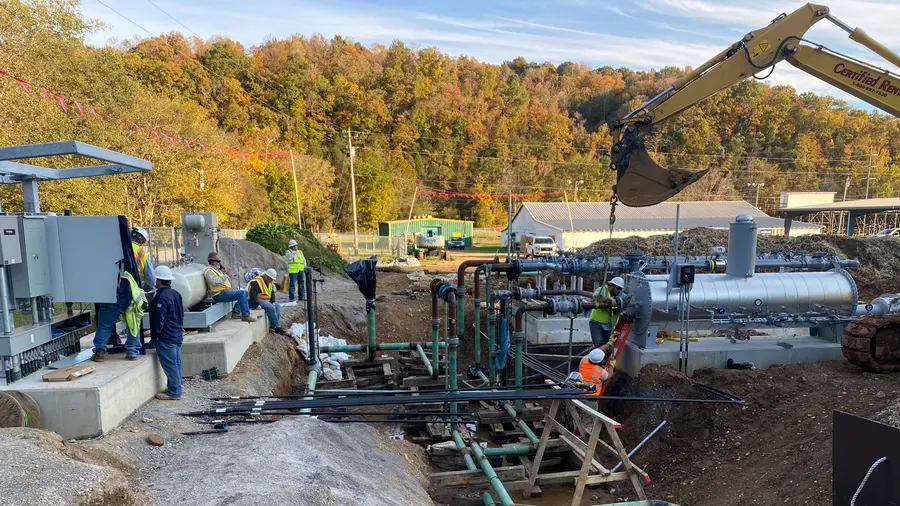
Civil construction is everything the station sits on and inside of. The site has to be cleared and graded so it drains correctly, because water sitting around equipment is a maintenance problem you will have forever. Concrete pads and foundations have to be poured and cured to hold the meters, the regulators, the filtration, and anything else the design calls for, and they have to be set to real tolerances because the equipment on top of them has to line up. There is an access road, because trucks and maintenance crews need to reach the site for the life of the station. There is fencing and security, because the station is a controlled facility. And there is restoration around all of it when the work is done.
None of that is glamorous, and none of it can be skipped. A station is only as good as the ground it is built on.
Station piping and equipment
Once the civil work is in, the station gets its piping and equipment. This is the fabrication and mechanical scope: the spools, fittings, valves, and assemblies that route product through the meters and regulators and back out to the line.
A lot of it is not straight pipe. It is the tie-in assemblies and the fabricated pieces that connect the station to the system, which is why fabrication and station work tend to travel together on a job. Welding standards do not relax because you are inside a fence line. Every weld still gets inspected, and the assemblies still have to be built to the design, because a station is a pressure facility like any other part of the line.
Then the equipment gets set on the foundations, tied in, tested, and commissioned. The station is proven before it ever goes into service, the same way the line itself gets tested before product moves through it.
The station and the line have to line up
Here is the part worth planning around. A meter station does not stand alone. It ties into the pipeline, and that tie-in is a real point of coordination.
When the station is built by one contractor and the line by another, that tie-in becomes a seam. The schedules have to be negotiated. The station has to be ready when the line reaches it, or the line has to wait. If a field condition changes on either side, two companies have to agree on what happens next, and you are the one in the middle. Nobody is acting in bad faith, but the structure itself creates a gap where time gets lost.
Building the station and the line under one contractor closes that gap. The tie-in gets planned as one job from the start, the crews doing the station work answer to the same superintendents running the spread, and there is one party accountable if something needs to move. That is one of the practical reasons self-performing across the scope matters on this kind of work. Fewer hand-offs means fewer places for the schedule to break.
When a station drives the schedule
On facility projects, and especially on gas service to data centers and power plants, the station is often the item that sets the pace.
The reason is simple. Pipe in the ground can be crewed up and moved along. Station equipment cannot. Meters, regulators, and control equipment carry lead times, and those lead times do not care how motivated your schedule is. The civil work has to be finished and cured before that equipment can be set, and the commissioning cannot start until the equipment is in. Each of those steps has to happen in order.
That is why the station belongs in the plan early, not at the end. If you are mapping a facility timeline, the honest question is not just how long the pipeline takes. It is when the station equipment gets ordered, when the pad gets poured, and when the tie-in window opens. Get those on the calendar early and the rest of the job has room to work.
Where station jobs usually go sideways
Station work does not fail dramatically. It slips quietly, and almost always in the same few places.
The first is the civil work getting treated as site prep instead of as construction. Grading that does not drain, a pad poured to loose tolerances, or foundations that do not match the equipment drawing all show up later, when the equipment arrives and does not sit the way it should. Fixing concrete after the fact is slow and expensive, and it happens on the critical path.
The second is equipment ordered late. Because the station is often scoped after the pipeline, the long-lead items get ordered after the long-lead pipe, and they arrive on their own clock. The civil crew finishes, and then everyone waits on a skid.
The third is the tie-in that nobody owned. The station is ready, the line is ready, and the two sides discover they had different assumptions about the connection, the pressure, or the window to make it. That is the seam we talked about, and it opens up most often when the two scopes came from different contractors.
None of these are exotic problems. They are planning problems, and they are avoidable. Asking a contractor to walk you through the station sequence, the equipment lead times, and how they would handle the tie-in is one of the more revealing questions you can ask before you sign. A contractor who has built stations will answer in specifics. One who has only built pipe will answer in generalities.
Plan the station with the line
If you have a facility that needs gas service, the meter station is not a footnote on the pipeline scope. It is a project with its own civil work, its own equipment, its own lead times, and its own tie-in into the line.
We self-perform meter station and civil construction with our own union crews, from the pad and the fencing through the station piping, the equipment, and the tie-ins. That means the station and the line that feeds it come from the same contractor, on one schedule, with one company answering for the result.
Request a bid or just get in touch and tell us what the facility needs, even if all you have so far is a site plan and a date you are trying to hit.
Frequently asked questions
What does a meter station do?
It measures and regulates the gas moving through a pipeline. Metering tells you how much product passed through, which is what the commercial side of the system runs on, and regulation controls the pressure so the downstream side gets what it is designed for.
What is included in the civil scope of a meter station?
The civil work is everything the station sits on and inside of: site grading and drainage, the concrete pad and equipment foundations, the access road, the fencing and security, and the restoration around it. Get it wrong and the equipment on top of it never sits right.
Why build the station and the pipeline with the same contractor?
Because they have to tie together. When the station and the line that feeds it come from the same contractor, the tie-in is planned as one job instead of two, and there is one party accountable if the schedule or the connection needs to change.
How early should a meter station be planned?
Early. Station equipment can carry long lead times, and the civil work has to be done before that equipment can be set. On facility projects, the station is often what sets the pace, so it belongs in the plan from the start rather than at the end.
Do you self-perform meter station work?
Yes. Meter station and civil construction is one of our self-performed specialized services, including the pad, the fencing, the station piping, the equipment setting, and the tie-ins into the line.