August 4, 2026
Stringing, Pipe Handling, and Right-of-Way Maintenance
Stringing and right-of-way maintenance move pipe into place and keep the route in shape before welding starts. Here is what the work covers.
Key takeaways
- Stringing lays sections of pipe out along the ditch, in order, ahead of welding, so the crews behind it are never waiting on material.
- Pipe handling protects the coating and the steel itself. Damage a joint before it goes in the ground and you have a repair or a reject on your hands.
- Right-of-way maintenance is not a one-time task. Access roads, erosion controls, and the cleared corridor have to hold up for the life of the job.
- This logistics work sets the pace for the whole spread. A welding crew is only as fast as the pipe and the road in front of it.
- Appalachian Pipeline self-performs stringing, handling, and right-of-way maintenance with its own crews, so the schedule stays in one set of hands.
A developer walked her right-of-way three weeks into the project and called her project manager that afternoon, worried. She had expected to see welding. Instead she saw long rows of pipe sitting in a field next to a freshly graded dirt road, with a few pieces of equipment moving slowly along it and no torches lit anywhere in sight. It looked, to her eye, like the job had stalled before it started.
It had not stalled. What she was looking at is some of the least visible and most necessary work on a pipeline construction job: stringing the pipe, handling it correctly, and keeping the right-of-way in shape for everyone who has to use it. None of that shows up in a highlight reel, but a spread cannot move without it, and it is worth understanding before you find yourself standing in a field wondering why nobody is welding yet. This is part of the same specialized scope that includes fabrication, coating, and station work.
What stringing actually is
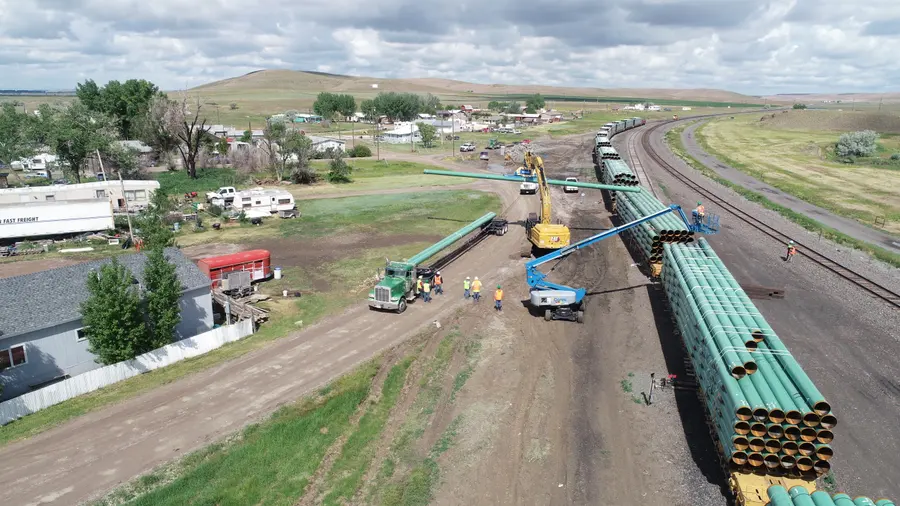
Stringing is the step where pipe gets hauled from the storage yard or the rail or truck delivery point out to the right-of-way, and laid end to end along the ditch line in the order it will eventually be welded. Trucks and pipe trailers move joint after joint down the cleared corridor, and a crew sets each one down where it belongs, spaced and aligned so the welding crew coming behind can pick it up, bend it if the terrain calls for a bend, and tie it into the line.
The word sounds simple, and the idea is simple, but the execution is not. Get the sequence wrong and a welding crew shows up to a section with the wrong diameter or the wrong wall thickness staged in front of them. Get the spacing wrong and equipment cannot maneuver between joints to do its work. Stringing has to run ahead of welding by the right margin, close enough that the welders never sit idle waiting on material, but far enough ahead that the string does not become an obstacle to the grading and ditching work still moving through the same corridor. It is a timing problem as much as a hauling problem.
Terrain changes the calculation too. On flat, open ground, a crew can string a long stretch in a day and not think much about it. On rolling or wooded ground, the same distance takes longer because trucks have narrower windows to work in and pipe has to be staged around bends, crossings, and places where the corridor pinches down. A contractor planning the string has to read the route the same way the welding and grading crews do, and adjust the pace to match what that particular stretch of ground allows.
Pipe handling is its own discipline
Once pipe is off the truck, how it gets touched matters. Every joint carries an external coating that protects the steel from corrosion once it is in the ground, and that coating is vulnerable to gouges, cracks, and abrasion long before the pipe ever sees soil. The steel underneath can be dented too, if a joint gets dropped, dragged across the ground, or set down on something hard and uneven.
That is why handling is treated as a distinct skill rather than an afterthought to hauling. Crews use padded slings, proper lifting points, and skids designed to keep pipe off bare ground. Equipment operators are trained to set a joint down gently instead of dropping it the last few inches. None of it is complicated in principle, but it has to be done correctly on every single joint, because a coating flaw or a dent found during final inspection means a repair at best and a rejected joint at worst, and either one costs time on a schedule that was built assuming the pipe would be ready to weld.
Right-of-way maintenance does not stop at clearing
People tend to think of the right-of-way as something you clear once and then forget about. In practice, it is closer to a road that has to stay usable for the entire length of the job, and roads take upkeep.
Access roads inside the corridor take heavy daily traffic from trucks, sidebooms, and welding rigs, and they rut, soften in wet weather, and need regrading to stay passable. Erosion and sediment controls, the silt fence and check dams that keep disturbed soil out of streams and low ground, have to be inspected and repaired after every hard rain, not installed once and left alone. Drainage across the corridor has to keep working so water does not pool where crews are trying to operate. All of that is right-of-way maintenance, and it runs the entire time the project is active, from the first week of clearing through backfill and often into restoration.
A landowner along the route usually notices this work more than any other part of the job, because it is the part that touches their property the longest. A gate left open, a fence not temporarily braced correctly, or a farm road left rutted after a rain are the kind of details that shape how a landowner remembers the project long after the pipe itself is buried and forgotten underground. Maintaining the right-of-way well is as much about that relationship as it is about keeping equipment moving.
Why this is the work that sets the pace
Here is the part that is easy to miss if you are not close to the job. A spread, the full chain of crews building a section of line, only moves as fast as its slowest link, and stringing, handling, and right-of-way maintenance sit right at the front of that chain. If pipe is not staged where the welders need it, the welders wait. If the access road has washed out overnight, equipment cannot get to where it needs to be that morning. Every hour lost at the front of the chain shows up as an hour lost everywhere behind it.
That is one reason what a spread actually is is worth understanding if you are trying to judge a contractor’s capacity. A contractor who talks only about welding speed or crew count is describing the visible part of the job. The logistics work in front of that crew, the stringing, the handling, and the road that gets everyone there, is what actually determines whether the visible part can run at full speed. A well-run spread has this groundwork so far ahead and so well maintained that it becomes invisible. You only notice it when it is missing.
Where it fits in a self-performed scope
On a job where the pipeline contractor subcontracts its logistics and right-of-way work, this becomes another hand-off to manage. The stringing schedule has to be coordinated with a separate company’s trucks, the road maintenance has to be requested from a crew that does not answer to the same superintendent running the welding, and if something falls behind, it is not always clear whose responsibility it was.
Appalachian Pipeline self-performs stringing, pipe handling, and right-of-way maintenance with the same crews and the same chain of command running the rest of the spread. That means the person deciding how far ahead the string needs to run is the same person accountable for keeping the welders moving, and the crew regrading the access road after a storm answers to the same superintendent who needs that road open the next morning. Fewer hand-offs means fewer places for a delay to hide.
What to ask if this is your project
If you are evaluating a contractor for a job of any size, it is worth asking a direct question about this piece of the work: who is running your stringing and right-of-way crews, and are they your own people or a sub. It is one of the questions worth asking before you sign, because the answer tells you something about how tightly the contractor controls their own schedule.
It is also worth asking what happens to the right-of-way after heavy weather, and how quickly access gets restored. A contractor who has a clear, practiced answer has done this before on ground like yours. A contractor who has to think about it has probably always had someone else handle that part.
None of this is the part of a pipeline job that gets photographed for a brochure. It is the part that determines whether the photographed part, the welding, the lower-in, the tie-ins, actually happens on schedule. The developer who called her project manager that day got a straightforward explanation: the pipe in the field was staged and ready, the road under it was built to carry the traffic coming, and the welding crews were two days out, right on plan.
If you have a project that needs this kind of groundwork handled by people who are also running the rest of the spread, get in touch and request a bid. Tell us about the route, and we will walk you through how we would stage and maintain it.
Frequently asked questions
What does stringing mean in pipeline construction?
Stringing is the process of hauling pipe to the right-of-way and laying it out end to end along the ditch line, in the sequence it will be welded. It happens after grading and before welding, and it is what keeps the welding crews supplied and moving.
Why does pipe handling matter so much?
A joint of pipe carries a coating that protects the steel underneath, and the steel itself can be dented or gouged if it is dragged, dropped, or set down wrong. Damage found before the pipe goes into the ground can usually be repaired. Damage found after is a much bigger problem, so handling is treated as a distinct skill on the job.
What counts as right-of-way maintenance?
It covers the access roads, erosion and sediment controls, drainage, and general condition of the cleared corridor for as long as the project needs it. That includes the early grading work and the upkeep that follows once equipment and crews are using the route every day.
Does right-of-way maintenance end once the pipe is buried?
Not immediately. Erosion controls and access roads usually need to hold through backfill, testing, and restoration, and sometimes through a season of weather after that before the land is fully returned to its original condition.
Who performs stringing and right-of-way work on a pipeline project?
On a self-perform contractor, the same company running the welding and lower-in crews also runs the stringing, pipe handling, and right-of-way crews. Appalachian Pipeline self-performs this scope with its own union crews rather than subbing it out.